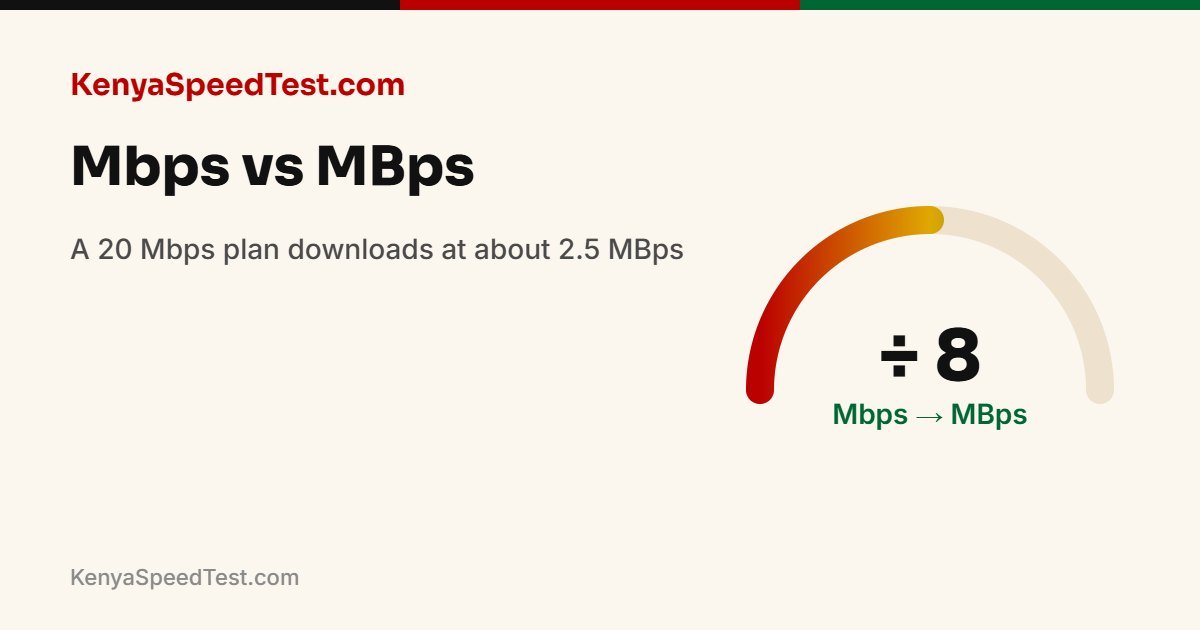
Mbps vs MBps is the most common source of speed test confusion. Your provider sells speed in megabits per second (Mbps), but your browser shows downloads in megabytes per second (MBps or MB/s). The difference is eight times.
The rule
One byte is eight bits. So MBps = Mbps ÷ 8. A small “b” means bit, and a capital “B” means byte.
Mbps vs MBps conversion table
| Plan speed (Mbps) | Max file download (MBps) | Time for a 1 GB file |
|---|---|---|
| 10 | 1.25 | about 13 min 20 s |
| 20 | 2.5 | about 6 min 40 s |
| 40 | 5 | about 3 min 20 s |
| 80 | 10 | about 1 min 40 s |
| 100 | 12.5 | about 1 min 20 s |
| 500 | 62.5 | about 16 s |
Mbps vs MBps in everyday life
When you pay for a 20 Mbps home fibre plan, you get 20 megabits per second. Steam, a browser or a download app usually shows megabytes per second. So you see about 2.5 MBps and think something is wrong, when it is actually normal.
Real downloads also land a little below the maximum. Network overhead and the speed of the server you download from both play a part.
Other units you may see
- Kbps: kilobits per second, one thousandth of a megabit.
- Gbps: gigabits per second, about 1,000 megabits.
- GB: gigabytes, used for file sizes and data bundles, not speed.
A worked example
Say you download a 50 GB game on a 40 Mbps plan. The maximum file speed is about 5 MBps. So the download takes nearly three hours in ideal conditions.
To find your speed in Mbps, run the internet speed test. Then divide by 8 to estimate your file download speed. For plan sizing, see what is a good internet speed.